
AI for local business
How to Prepare Your Business for AI Agents That Search and Book for Customers
A clear guide to connecting Local SEO, Business Profile, pages, schema, booking, pricing, reputation, automation, and staff training.
Quick answer
Customers can increasingly ask an AI agent to find a nearby service, compare options, and help them reach a booking. A competitive local business needs accurate public information, a complete Business Profile, indexable service and location pages, clear answers, real reputation, and an easy way to call, message, or check availability. Schema and JSON-LD can describe visible facts, but they are not an automatic pass or a guarantee. The advantage comes when discovery, response, booking, service, and follow-up work as one practical system.
How to use this guide
This guide is written for local business owners and operating leaders. It separates verifiable foundations from sales promises: Google does not require special AI schema for its AI features, and there is no universal word count that guarantees ranking. Depth should match the reader’s decision. This resource is detailed because the topic requires strategy, operations, measurement, and accountability, not because 2,000 words are a magic ranking factor.
Business AI is more than ChatGPT and image generation
Many owners hear artificial intelligence and picture a ChatGPT conversation or an app that creates an attractive image. Those are real capabilities, but local-business value is broader. AI can help organize information, answer approved questions, capture calls, identify the requested service, check a calendar, confirm appointments, support follow-up, and show a team what needs attention. The purpose is not to display technology. It is to win customers, recover time, and improve service.
Start with one simple question: where is money being lost today? A call may go unanswered, a profile may use the wrong category, a page may not explain the service area, or a quote may receive no follow-up. Each problem needs a different response. The owner does not need to become a technician; the implementation should make the path clearer for the customer and easier for the team.
Sofia's story: from a request to an appointment
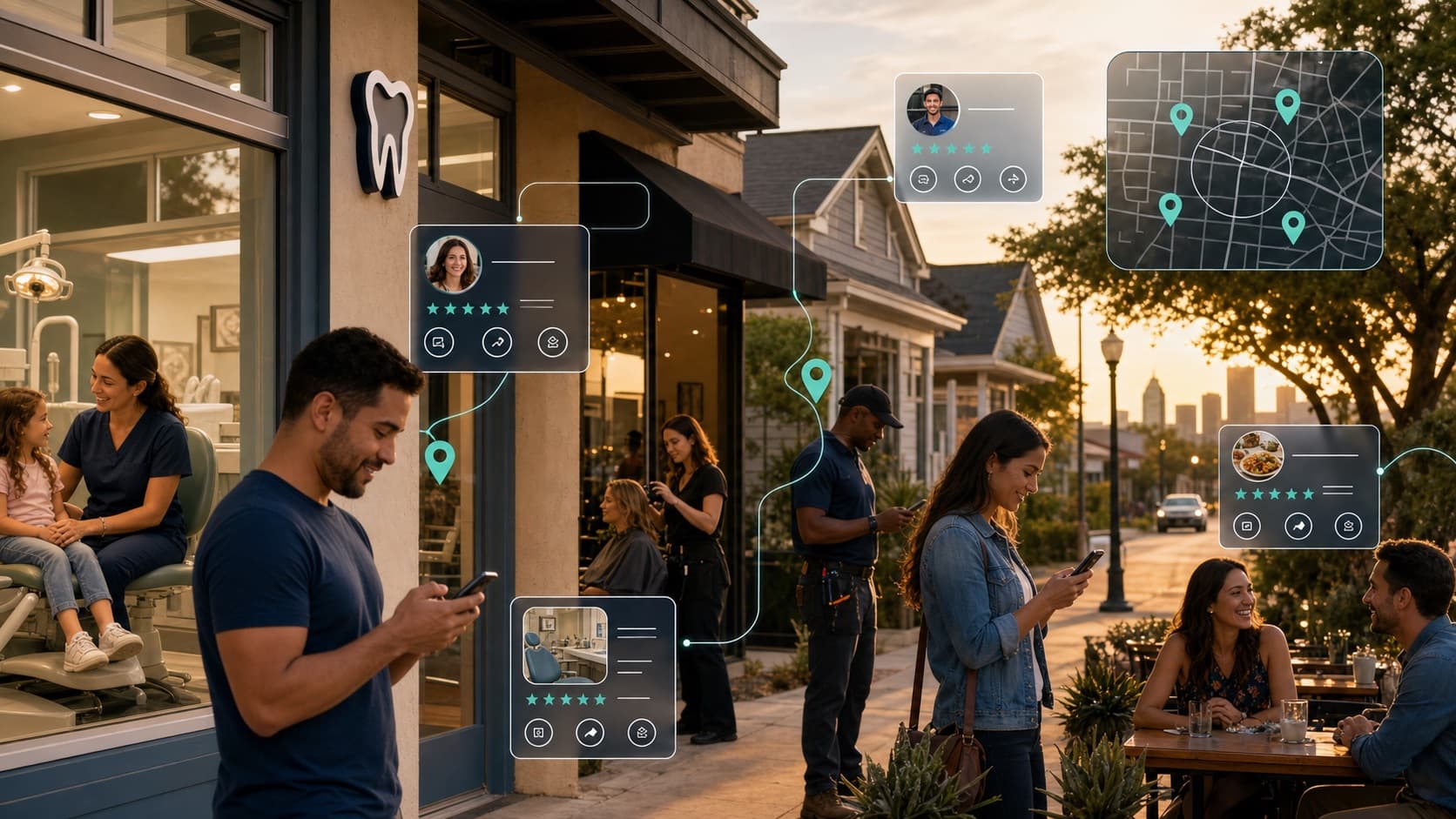
Imagine Sofia needs a specific dental service near work, in Spanish, after 2 p.m. on Thursday. Instead of opening ten websites and calling three offices, she asks an AI agent to find suitable options and check availability. The agent can break down the request, search public information, compare businesses, and present options that appear to match.
OpenAI describes agents that can find specialists and schedule appointments. Google has shown AI search capabilities that look across platforms and websites for restaurant, beauty, wellness, and local-service availability. Availability varies by tool, market, partner, and level of supervision, so no business should promise universal automated booking. The direction is what matters: software can perform more of the comparison and navigation work for customers.

What a system may need before presenting an option
An agent may face familiar questions: does this provider offer the service, serve the location, appear trustworthy, explain the process, and provide a usable next step? Sources can include search indexes, maps, profiles, websites, reviews, booking platforms, and authorized databases. No agency can guarantee the exact source mix for every request.
Consistency reduces uncertainty. The public name, domain, phone, hours, areas, categories, services, languages, policies, and publishable pricing should agree across sources. Pages should be indexable, internally linked, mobile-friendly, and available in text. Calls, messages, forms, and calendars must work because discovery has little value when the action is broken.
- Clearly identified service and location
- Real hours, coverage, and delivery method
- Visible reputation, evidence, and policies
- Useful questions, process, and pricing
- Working call, message, email, and booking paths
Local SEO remains the foundation
AI answers do not eliminate Local SEO. Google says foundational SEO remains relevant to its AI features and that a page must be indexed and eligible for Search. A local business still needs a complete profile, accurate categories and hours, legitimate reviews, useful service pages, real location context, technical access, and local authority.
Location pages should help someone in that market rather than swap city names in a template. Explain real coverage, delivery method, local questions, language support, and the path to service without inventing offices. Measure qualified calls, bookings, close rate, and customer value alongside map rankings.
Google Business Profile is a door, not the whole house
Google Business Profile is often the first public version of a company. Its name, categories, phone, URL, hours, services, photos, posts, and reviews shape an immediate decision. Maintenance should correct facts, publish useful updates, respond to reviews thoughtfully, and monitor actions. Repeated robotic replies are not a customer-experience strategy.
The profile cannot answer every buying question. The website owns deeper explanations of services, locations, process, team, policies, useful pricing, proof, and contact paths. Profile and website should reinforce one another: discovery leads to understanding, and understanding leads to an action.
Schema and JSON-LD are useful, not magical
Schema Markup describes information and relationships in a machine-readable vocabulary. JSON-LD is a common format for placing those descriptions on a page. Organization, LocalBusiness, Service, Person, Article, Breadcrumb, and FAQ types can represent visible content when they genuinely apply.
Google recommends JSON-LD for supported rich-result features, but states that correct markup does not guarantee a special appearance and that no additional AI schema is required for AI Overviews or AI Mode. It is inaccurate to claim that every business without JSON-LD is automatically rejected. Publish useful facts first, describe the same facts accurately, validate the implementation, and maintain both together.
Services, questions, pricing, and transparency support decisions
A business may need to quote based on scope, condition, materials, or urgency, but it can still explain how price is determined, what is included, and what information is required. Clear process and pricing guidance help people and agents compare without creating a false promise.
Each priority service page should explain the problem, fit, process, deliverables, timing, prerequisites, limits, measurement, and next step. FAQs should come from calls, messages, reviews, Search Console, and staff. Keep private or regulated information behind appropriate controls and define what automation must escalate.
The calendar must represent real capacity
A visible calendar converts interest only when it represents real operations. Service types, duration, staff, locations, buffers, preparation, cancellation, and confirmation must be documented and tested. Automation will accelerate a bad experience if availability is wrong.
Plan exceptions. Urgent conditions, unclear services, language needs, unusual schedules, and sensitive questions may require a person. Payments and other consequential actions need security, consent, and appropriate confirmation. The aim is to remove repetitive friction without removing meaningful control.
Employee training protects the investment
Technology does not retain employees by itself. People improve when expectations are clear, tools reduce frustration, real situations are practiced, and exceptions have an owner. One source of truth keeps every employee from memorizing a different version of the service.
Explain which repetitive tasks automation handles, which decisions remain human, and how to report a wrong answer. Measure time to find information, transfers, duplicate work, scheduling mistakes, and supervision needs. A prepared employee creates stronger service, reviews, referrals, and repeat business.

Fast response keeps demand away from competitors
A person who has decided to contact you does not want to restart the search. Make calling, SMS, WhatsApp, email, booking, and scanning easy on mobile. Not everyone wants a sales meeting; some people only need one question answered.
Automation can confirm receipt, collect basic context, answer approved questions, and assign an owner. It should not pretend to be human or trap someone in a loop. Measure time to the first useful response, appointments, attendance, opportunities, close rate, and loss reasons. The next investment should follow the point where revenue stops.
What a local business should prepare now
Begin with an inventory of profiles, domains, pages, phones, calendars, services, locations, directories, analytics, CRM, reviews, and training materials. Assign ownership and use secure platform permissions. Never expose private credentials or webhooks in client code.
Choose one profitable service and one priority market. Build a useful page, connect the profile, explain process and pricing, add legitimate proof, implement matching structured data, and test every mobile action. Assign monthly maintenance because hours, services, staff, platforms, and customer questions change.
Measure whether readiness is producing revenue
Record a baseline before making changes: indexation, errors, mobile performance, local visibility, profile actions, calls, messages, forms, bookings, attendance, opportunities, close rate, revenue where attributable, review themes, and repeat customers. AI references can be sampled, but one screenshot does not represent the market.
Organize reporting into technical health, discovery, conversion, and experience. Every metric needs a period, source, published change, and next decision. The durable outcome is a clearer profile, stronger page, reliable calendar, trained team, and measurable follow-up that continue creating value as interfaces change.
Working session
Readiness workshop: trace one appointment from search to service
Choose one profitable service and one real market. Ask someone unfamiliar with the business to find it, understand the offer, and attempt to book from a phone. Record every doubt, contradiction, broken action, or fact that exists only in an employee's memory. Assign an owner and date to each correction.
Repeat the test with a conversational question someone might give an AI agent. Compare the website, Google Business Profile, local pages, reviews, calendar, and confirmation. The goal is not to trick a system; it is to create a clear public experience that also works for people.
Questions for your working session
- Which service and market did we test?
- What information was hard to find?
- Was availability real?
- Who responds when automation is uncertain?
- Which metric connects the improvement to revenue?
Implementation
Action plan for the next six months
The order protects existing assets and prevents publishing more pages before knowing what they must solve. Adjust the pace to available resources, but preserve the sequence: measure, correct, build, connect, and learn.
- 01
Week 1: scan and document
Record visibility, profiles, pages, contradictions, mobile actions, calls, and bookings.
- 02
Week 2: create a source of truth
Approve name, domain, phones, hours, markets, categories, services, languages, policies, and owners.
- 03
Weeks 3–4: repair the main journey
Improve one service and market, then connect profile, answers, pricing, proof, contact, and booking.
- 04
Month 2: implement honest structured data
Describe visible facts, validate syntax, indexation, canonicals, internal links, and language versions.
- 05
Month 3: connect response and follow-up
Define calls, SMS, WhatsApp, email, chat, voice, CRM, response times, and human escalation.
- 06
Months 4–6: train, measure, and expand
Compare qualified visibility, calls, bookings, close rate, and retention before expanding.
A dashboard the business can understand
Report results in four layers: technical health, discovery, conversion, and customer experience. Include the baseline, work completed, observed change, and next decision. A chart without context does not prove causality, and one ChatGPT screenshot does not represent the market. Keep comparable samples, annotate site or campaign changes, and connect each metric to calls, appointments, opportunities, or service quality.
Technical
Indexation, performance, canonicals, and errors
Discovery
Queries, Maps, rankings, and referrals
Conversion
Calls, appointments, quality, close rate, and revenue
Experience
Response, reviews, retention, and referrals
FAQ
Frequently asked questions
Direct answers that turn technical concepts into business decisions.
Will AI agents reject a business without schema?
There is no universal automatic rejection rule. Google says no special AI schema is required. Accurate markup helps describe facts, while indexation, content, profiles, reputation, links, availability, and experience also matter.
Can an AI agent book and pay for every service today?
No. Capabilities depend on the tool, country, platform, integration, permissions, and action. Some experiences find availability or assist with booking, and consequential steps may require confirmation.
Does AI readiness replace Local SEO?
No. Local SEO remains part of the foundation: profiles, categories, pages, reviews, authority, technical access, and geographic relevance help people and systems discover the business.
How can a small business begin?
Scan the business, correct the profile, select one service and one market, improve that page, and connect a working contact path. Measure before expanding.
Sources and official reading
Search practices change. These primary sources let you verify the recommendations and review future updates.